



Teaching Java to Students With Disabilities: What Designing Accessible CS Curriculum Taught Me
During winter break, I worked as a teaching assistant at Stanbridge Academy in San Mateo, CA—a school that serves neurodiverse learners, including students with ADHD, anxiety, and various learning disabilities. I was drawn to the externship because of my previous experience tutoring math at Carleton's Math Skills Center, where I discovered how much I loved explaining ideas, learning from students, and collaborating to solve problems.
The opportunity at Stanbridge felt like the perfect next step.
Arriving and Settling In
After applying to the externship, I received my acceptance email a few weeks later. Housing became my first major challenge: although I briefly found a place in San Francisco owned by the parents of a Carleton student, the two-hour train commute made it unrealistic. I eventually booked an Airbnb closer to the school—a decision that saved me hours each day and made the experience far more sustainable.
Everything else flowed surprisingly smoothly. I coordinated details with my externship host, Jay Huston; booked my flight; and secured funding from the Career Center. On November 25th, 2023, I landed in San Francisco to warm weather and a sense of excitement for what was ahead.
Entering the Classroom
My first day at Stanbridge was filled with new experiences. The students were warm and welcoming, and I connected quickly with another Carleton extern, Nate, whose presence made the transition easier. For the first week, I shadowed Jay—an energetic, endlessly creative teacher who doubled as the head of the high school. A Carleton alum from the class of 2000 (and a former comedian), he brought humor, compassion, and spontaneity into every lesson.
I observed courses across the spectrum: math, design, chemistry, biology, and computer science. By the second week, I began teaching Java to a small class of five high school students using BlueJ. The curriculum covered introductory computer science topics through object-oriented programming and graphics.
Designing Accessible CS Curriculum
Teaching neurodiverse students forced me to rethink the way programming is usually introduced. Many traditional CS explanations depend heavily on abstract reasoning—something that can feel inaccessible or overly taxing for students with ADHD or processing disorders.
I quickly learned to adapt.
Visual Scaffolding
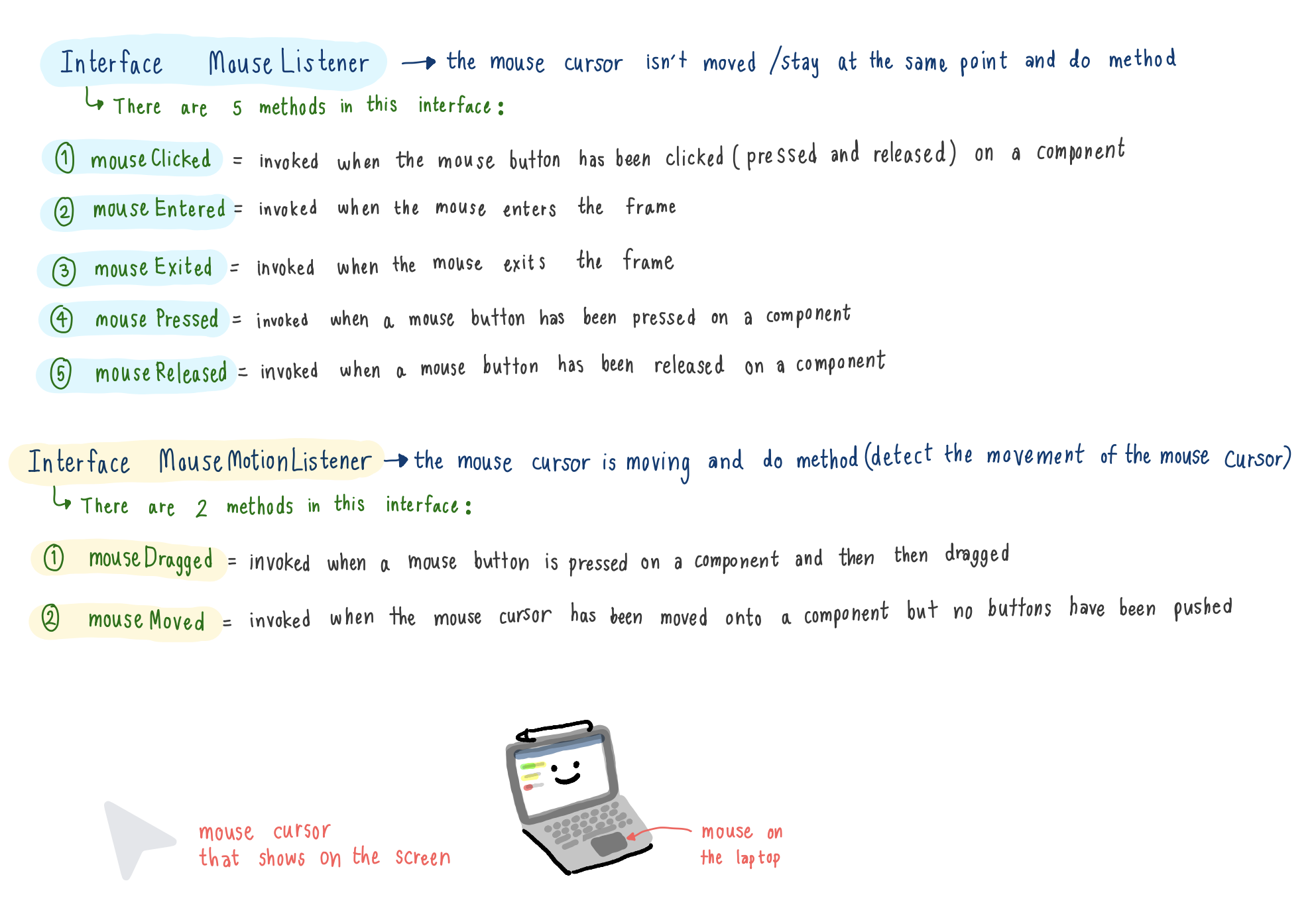
I created illustrated worksheets, diagrams, and short visual booklets to break down Java libraries, objects, and classes. Concepts like Random, coordinate planes, or event listeners became easier to grasp when supported by drawings and step-by-step visuals rather than long textual descriptions.
Reducing Cognitive Load
Instead of presenting full Java programs upfront, I broke lessons into smaller chunks:
- One idea
- One concept
- One code block
This approach made debugging more concrete and less overwhelming.
Interactive and Hands-On Activities
To keep students engaged, I designed activities that invited experimentation. For instance, when teaching the MouseListener interface, I created an interactive mini-project where students could draw shapes by clicking around the canvas. This helped them feel the connection between code and action.
Unexpected Breakthroughs
The beauty of teaching neurodiverse learners is that breakthroughs come in unexpected moments. A student who struggled to stay focused during lectures produced an elegant debugging solution during a hands-on exercise. Another, who found syntax frustrating, lit up when we used visuals to map out object interactions.
These moments taught me that accessibility is not just an accommodation—it’s a catalyst for deeper understanding.
What the Experience Taught Me
My externship at Stanbridge reshaped my understanding of what inclusive computer science education can look like.
Empathy Drives Good Teaching
Before writing code, students need clarity, patience, and a sense of safety. Accessibility is a form of empathy.
Visuals Are Not “Extras”
For many learners, visual scaffolding is the difference between confusion and understanding.
Flexibility Matters
Every student learns differently; teaching requires adapting, iterating, and letting go of rigid lesson plans.
Technology Should Be Inclusive by Design
These students were fully capable of learning Java—they simply needed curriculum that respected diverse cognitive needs.
This experience reaffirmed my belief that technology and education must center accessibility, not as an afterthought, but as a foundational principle.
Tips for Future Externs
Consider Housing Carefully
Choose convenience over cost if it impacts your commute and energy.
Build Connections
Your host, peers, and students are invaluable resources.
Observe Other Classes
Great teaching ideas often come from outside your subject area.
Document and Reflect
Journaling helps track growth, challenges, and small victories.
Be Proactive and Creative
Design lessons that blend clarity, play, and structure.
Conclusion
Teaching Java at Stanbridge Academy was one of the most meaningful educational experiences I’ve had. It taught me how to design inclusive curriculum, collaborate with neurodiverse students, and build learning environments rooted in empathy and clarity. More importantly, it showed me that accessibility is not just about meeting needs—it’s about unlocking potential.
By embracing inclusive pedagogy and creative problem-solving, educators can help every student discover confidence in their own abilities.